Why Experience Matters Even More in the Age of AI-Assisted Enterprise Development
 Daniel Strmečki
AI-assisted development is significantly reducing the time required to implement software. However, the ability to generate code faster does not necessarily translate into the ability to build better software. This distinction is particularly important in enterprise development, where platforms are expected to evolve continuously, support complex business requirements, and remain maintainable for many years.
With AI tools becoming increasingly capable of analyzing codebases, implementing features, writing tests, and even proposing architectural changes, it is easy to understand why some organizations are questioning the need for expensive senior developers. If AI can do much of the implementation work, why not build delivery teams around less experienced developers who can leverage these tools at a significantly lower cost?
In my opinion, AI makes a much stronger argument for doing exactly the opposite. The faster we can implement software, the more important it becomes to have experienced engineers who understand what should be implemented, how it should be implemented, and what the long-term consequences of those decisions will be.
AI Accelerates Development, Not Engineering Expertise
Writing code has always been just one part of software development. In enterprise projects, much of the complexity comes from understanding existing architectures, evaluating business requirements against existing platform capabilities, defining integration boundaries, and ensuring that new functionality does not negatively impact performance, security, scalability, or maintainability.
AI can help with all of these activities, but it does not automatically make the right decisions. An AI agent can implement a technically valid solution that is unnecessarily complex, duplicates functionality already available in the platform, or introduces dependencies that make future changes significantly more difficult. From a purely functional perspective, the implementation may be correct. From an engineering perspective, it may be a solution we should never have introduced in the first place.
This is where experience becomes particularly valuable. Experienced engineers understand that the objective is not simply to implement a requirement, but to implement it in a way that fits the existing architecture and keeps the cost of future changes under control. AI significantly reduces the effort required to implement a decision, but it does not reduce the importance of making the right decision.
This becomes particularly important on platforms that support multiple brands, markets, and business units. A decision that seems entirely reasonable when implementing functionality for one website can become a significant limitation when the same functionality needs to support another 100 websites. An experienced engineer will consider whether the requirement is specific to one market or represents a capability that should be available across the platform, whether it should be implemented through configuration or custom code, and whether the existing architecture needs to evolve at all. These are decisions that need to be made before implementation, regardless of how quickly AI can generate the code.
How Experienced Engineers Leverage AI
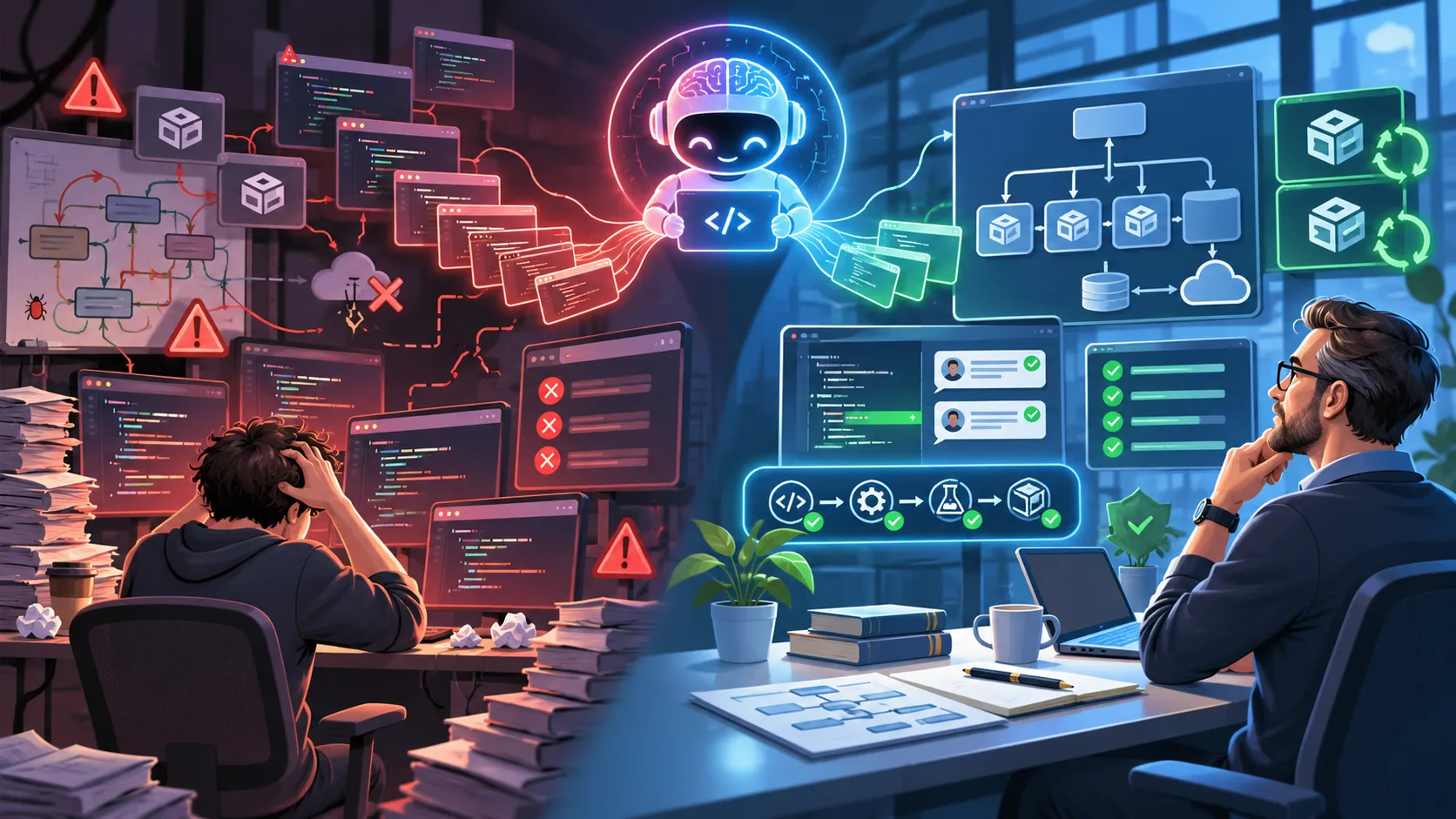
One of the biggest advantages of AI-assisted development is that experienced engineers can spend less time on repetitive implementation work and more time on understanding requirements, evaluating solutions, and ensuring implementation quality. Instead of manually writing every class, component, or test, they can delegate much of that work to AI while maintaining control over the architecture and implementation.
For complex requirements, an effective AI-assisted development workflow typically involves:
- Analyzing the existing implementation and identifying opportunities for reuse
- Defining architectural boundaries, technical constraints, and quality requirements
- Generating and reviewing an implementation plan before making changes
- Breaking the implementation into smaller, well-defined steps
- Reviewing generated code and challenging unnecessary complexity or incorrect assumptions
- Validating the implementation through automated tests, performance testing, and other relevant quality gates
Having an AI agent generate an implementation plan is particularly valuable, but only if the engineer reviewing that plan has sufficient experience to identify problems before implementation begins. Correcting a flawed architectural assumption at this stage is significantly easier than correcting an entire implementation built around it.
The same applies to reviewing generated code. AI can hallucinate APIs, misunderstand framework behavior, introduce unnecessary abstractions, or make changes that have unintended consequences elsewhere in the platform. Experienced engineers are more likely to recognize these issues because they understand the underlying technologies, the existing architecture, and how the application behaves in production.
Another important aspect is how much implementation work we allow an AI agent to perform before reviewing its output. If we ask an agent to implement a complex feature across multiple layers of an enterprise application in one go, we may end up with changes across dozens of files. Even if the implementation works, reviewing all those changes and identifying architectural inconsistencies can become more time-consuming than implementing the feature incrementally. Reviewing each implementation step allows us to correct the direction early, before subsequent changes start relying on decisions we would not have made ourselves.
Automated quality gates become even more valuable in such an environment. Code quality checks, automated functional tests, accessibility tests, performance tests, and security checks should be part of the development and deployment process, regardless of whether code is written manually or generated with AI. However, the engineer still needs to understand what those checks actually validate. AI can generate tests very quickly, but defining what needs to be tested, under which conditions, and with which acceptance criteria remains an engineering responsibility.
How Do You Know If You Are Working with Senior Developers?
Software development has always been more about understanding why something should be implemented in a particular way than knowing how to implement it. There are usually multiple ways to implement the same requirement, and what differentiates experienced engineers is their ability to evaluate these alternatives, understand the associated trade-offs, and make decisions based on the specific requirements and constraints of the platform they are working on.
When reviewing an implementation or discussing a technical solution with a developer, I am typically much more interested in the answers to the following questions than in the implementation itself:
- Why was the solution implemented in this particular way?
- What alternative approaches were considered and why were they rejected?
- How does the underlying technology work, and what are its limitations?
- What trade-offs were made during the design and implementation?
- How does the implementation impact the performance, security, scalability, and maintainability of the platform?
- How easily can the solution be extended to support future requirements?
If a developer can implement a solution but cannot explain why it was implemented in a particular way, how it works under the hood, or what the consequences of the design decisions are, I would not consider that developer a senior engineer, regardless of their job title or years of professional experience.
This distinction becomes particularly important with AI-assisted development. Previously, implementing a complex technical solution typically required developers to have at least a certain level of understanding of the underlying technologies. Today, developers can generate relatively complex implementations without necessarily understanding the technologies, patterns, or architectural decisions behind them. They can even ask AI to generate documentation explaining those decisions, without having critically evaluated any of them themselves.
Experienced engineers, on the other hand, can challenge the solutions proposed by AI, recognize when an alternative approach would be more appropriate, and understand when the additional complexity of a particular implementation is justified and when it is not. They also understand that the technically most sophisticated solution is not necessarily the best solution for a particular enterprise platform.
This is why I believe that organizations should place even greater emphasis on engineering fundamentals, architectural understanding, and critical thinking when hiring developers. The ability to implement functionality is becoming increasingly accessible. The ability to understand, evaluate, and take responsibility for engineering decisions is what will increasingly differentiate experienced engineers from the rest.
When AI Amplifies Poor Engineering Practices
Developers with insufficient implementation know-how have always introduced problems into enterprise platforms. Duplicated code, inefficient database queries, unnecessary customizations, poor separation of responsibilities, and inadequate test coverage are not new problems introduced by AI. However, the amount of code an individual developer could produce was previously limited by how quickly that developer could implement a solution.
With AI-assisted development, much of that limitation disappears. A developer can now generate several components, services, integrations, and corresponding tests within a relatively short period of time, without necessarily understanding the architectural decisions made during implementation.
The biggest risk is not that AI occasionally generates incorrect code, but that the developer responsible for reviewing that code may not have sufficient expertise to recognize why it is incorrect. If the application builds successfully, the generated tests pass, and the functionality appears to work, the implementation may be considered complete.
This is especially problematic when the same AI agent generates both the implementation and the tests based on the same incorrect assumptions. Good code coverage and passing tests can create a false sense of confidence, while important scenarios related to security, concurrency, error handling, or performance remain untested.
Another pattern worth considering is how developers resolve problems introduced by AI-generated implementations. If a developer does not understand why an implementation fails, the natural reaction may be to ask the agent to fix it. The agent might introduce additional abstractions, fallback mechanisms, or workarounds instead of correcting the underlying problem. After several such iterations, the functionality may eventually work, but the resulting implementation can be significantly more complex than the original requirement justified.
This also changes the dynamics of code reviews. If several developers can generate substantial implementations within a few hours, the experienced engineers responsible for reviewing those implementations may become the bottleneck. The time saved during implementation is then partially or entirely lost during review, architectural corrections, and repeated QA cycles. Worse, if reviewers are under pressure to keep up with the increased volume of changes, more of these issues may reach production.
Technical Debt Can Now Accumulate Faster Than Ever
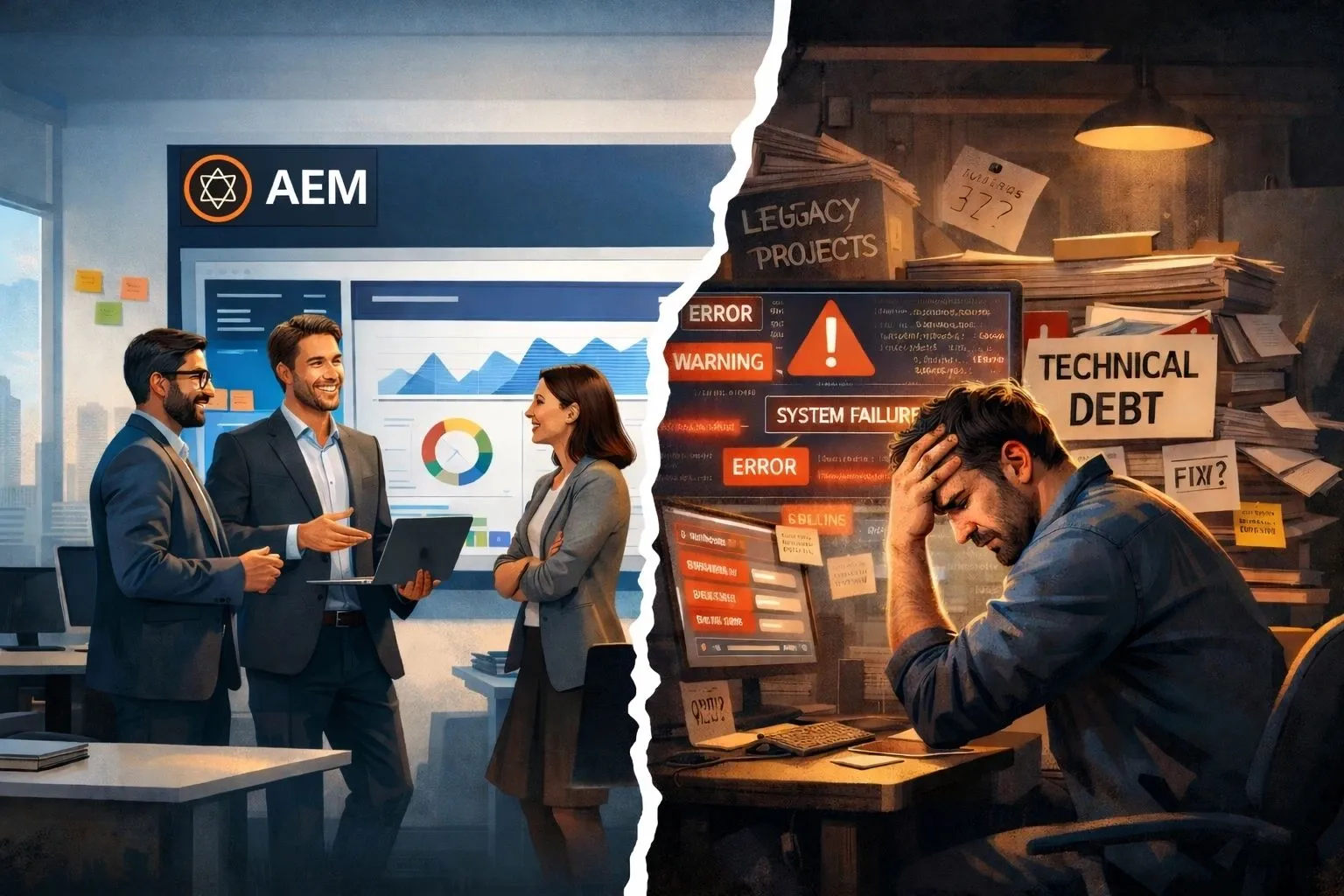
Enterprise platforms rarely become difficult to maintain because of a single implementation. Complexity accumulates gradually, through hundreds of individually reasonable decisions made without sufficient consideration of their long-term impact. AI-assisted development does not change this pattern, but it can significantly accelerate it.
If development teams introduce new functionality faster without maintaining the same level of architectural oversight and engineering discipline, technical debt can accumulate faster as well. This may not be immediately visible to business stakeholders. More features are delivered, more pull requests are merged, and delivery milestones are reached faster. The platform appears to be evolving successfully.
The real cost becomes visible later, when changes require modifications across multiple services, similar functionality exists in several places, automated tests become increasingly difficult to maintain, and upgrades require extensive regression testing. The organization ends up spending a growing portion of its development budget maintaining functionality that could have been implemented much more simply.
This is why enterprises should be careful about how they measure productivity in the context of AI-assisted development. The amount of code generated, the number of completed tickets, and even the speed at which individual features are delivered tell us very little about the long-term health of a platform. The objective should be to deliver business functionality faster while keeping the platform maintainable, not simply to increase development throughput.
One of the biggest opportunities with AI is actually to reduce existing technical debt. Activities such as analyzing duplicated implementations, identifying outdated dependencies, improving test coverage, and refactoring existing code can require significantly less manual effort. However, this requires a team that continuously evaluates the health of the platform and understands which changes will make it easier to maintain. If all the additional development capacity provided by AI is allocated to new business requirements, without addressing the complexity that already exists, we are missing an important opportunity to reduce the long-term cost of enterprise software delivery.
AI Challenges Traditional Low-Cost Delivery Models
For years, many enterprises have tried to optimize software development costs by moving implementation work to large, relatively inexpensive offshore delivery teams. A small number of senior architects and technical leads define the architecture, while a much larger number of developers implement individual requirements. On paper, this model looks financially attractive because most implementation hours are billed at significantly lower rates.
AI-assisted development challenges one of the fundamental assumptions behind this model: that implementing software requires a large amount of developer time, and that reducing the cost of those hours is the most effective way to reduce overall delivery costs.
Let's use a simplified example of two delivery teams, based on 160 billable hours per person per month. A 15-person offshore team at €30 per hour costs €72,000 per month. A five-person senior European team at €90 per hour also costs €72,000 per month.
Historically, the offshore team might have looked more attractive because it provided three times the implementation capacity in terms of developer hours. However, when both teams leverage AI-assisted development, the number of hours alone becomes an even less useful indicator of delivery capacity. How much functionality can each team deliver? How much architectural oversight, coordination, and rework is required? And what will the resulting implementation cost to maintain over the next five years?
This is not a claim that five senior engineers will always outperform 15 offshore developers. The rates and team sizes are illustrative, and the actual delivery capacity depends on the expertise of the people involved, the nature of the work, and the maturity of the platform. However, as AI reduces the amount of manual implementation work required, the ability to make good engineering decisions becomes an increasingly important part of the budget equation.
The issue is not offshore delivery itself. There are excellent engineers in every region. The issue is when enterprises purchase low-cost development capacity instead of engineering expertise. If the delivery model requires constant supervision, repeated code reviews, architectural corrections, and extensive QA cycles, the ability to generate more code may only increase the amount of work required from the experienced engineers overseeing delivery.
Another important consideration is where the productivity improvement actually occurs. If AI reduces the implementation effort for both teams by the same proportion, that alone does not make the smaller team more cost-effective. The advantage comes from how much of the overall delivery effort can be eliminated through better decisions, reuse, fewer handover points, and less rework. A team that can solve a requirement by extending an existing service does not need to generate, review, test, and maintain another service, regardless of how inexpensive it has become to generate one. This is the same fundamental problem with enterprise delivery budgets that existed before AI, but it is becoming much more relevant now that generating additional code is no longer particularly expensive.
Rethinking Enterprise Development Team Composition
One of the most interesting opportunities AI brings to enterprise development is the ability to scale delivery without proportionally scaling headcount. A smaller team of experienced engineers with clear technical ownership can leverage AI to handle much of the repetitive implementation work that previously required additional development capacity.
For European enterprises in particular, this makes smaller senior European delivery teams an increasingly interesting alternative to large low-cost offshore delivery models. Beyond engineering expertise, such teams can benefit from overlapping working hours, closer collaboration with business stakeholders, and fewer layers of communication between the people making architectural decisions and the people implementing them.
The objective is not to replace developers with AI or to assume that every enterprise should operate with a small team. It is to reconsider where additional development capacity creates value and where it primarily introduces more coordination, supervision, and long-term maintenance work.
This also does not mean that enterprises should stop hiring junior developers. AI can be a very valuable learning tool when developers use it to understand technologies, explore implementation alternatives, and receive feedback on their work. However, generating implementations that work without understanding why they work is not a substitute for developing engineering expertise. Mentoring and hands-on involvement from experienced engineers become even more important in such an environment.
When evaluating delivery partners, enterprises should therefore look beyond the number of developers a partner can provide and whether those developers have access to AI tools. How involved are the architects in day-to-day delivery? Who reviews implementation plans and code? Who is responsible for ensuring that new functionality remains consistent with the existing architecture? What automated quality gates are in place, and who owns the platform once functionality has been released into production? These questions were important before AI-assisted development, and they become even more important when teams can introduce changes at a significantly higher rate.
Conclusion
AI-assisted development is one of the most significant opportunities to improve enterprise software delivery. However, how much value organizations get from it will depend heavily on the engineering expertise and delivery models they have in place. AI can help experienced engineers deliver high-quality solutions faster, but it can also help poorly governed teams introduce unnecessary complexity and technical debt faster than ever before.
For years, enterprises have optimized software development costs by reducing the cost of a developer's time. Now that AI is significantly reducing the time required to write code, perhaps it is time to start optimizing for the quality of engineering decisions instead.
The value of an experienced software engineer was never primarily in how quickly they could write code. It was in knowing what code should be written, how it should be written, and often, what code should not be written at all.
At Meticulous Digital, this is how we have approached enterprise development from the beginning. We have always believed in smaller, highly skilled delivery teams, architects who remain actively involved in implementation, clear technical ownership, and a strong focus on quality, reusability, and long-term maintainability. AI has not changed the way we think about enterprise software delivery. It has allowed us to deliver faster while reinforcing our belief that this was the right delivery model to begin with. We do not need to relax our engineering standards to benefit from AI. On the contrary, having those standards in place is what allows us to leverage AI effectively.
If you are reconsidering how your enterprise development teams are structured or how to leverage AI-assisted development without compromising the long-term maintainability of your platform, learn more about our approach or get in touch with us.