Daniel Strmečki
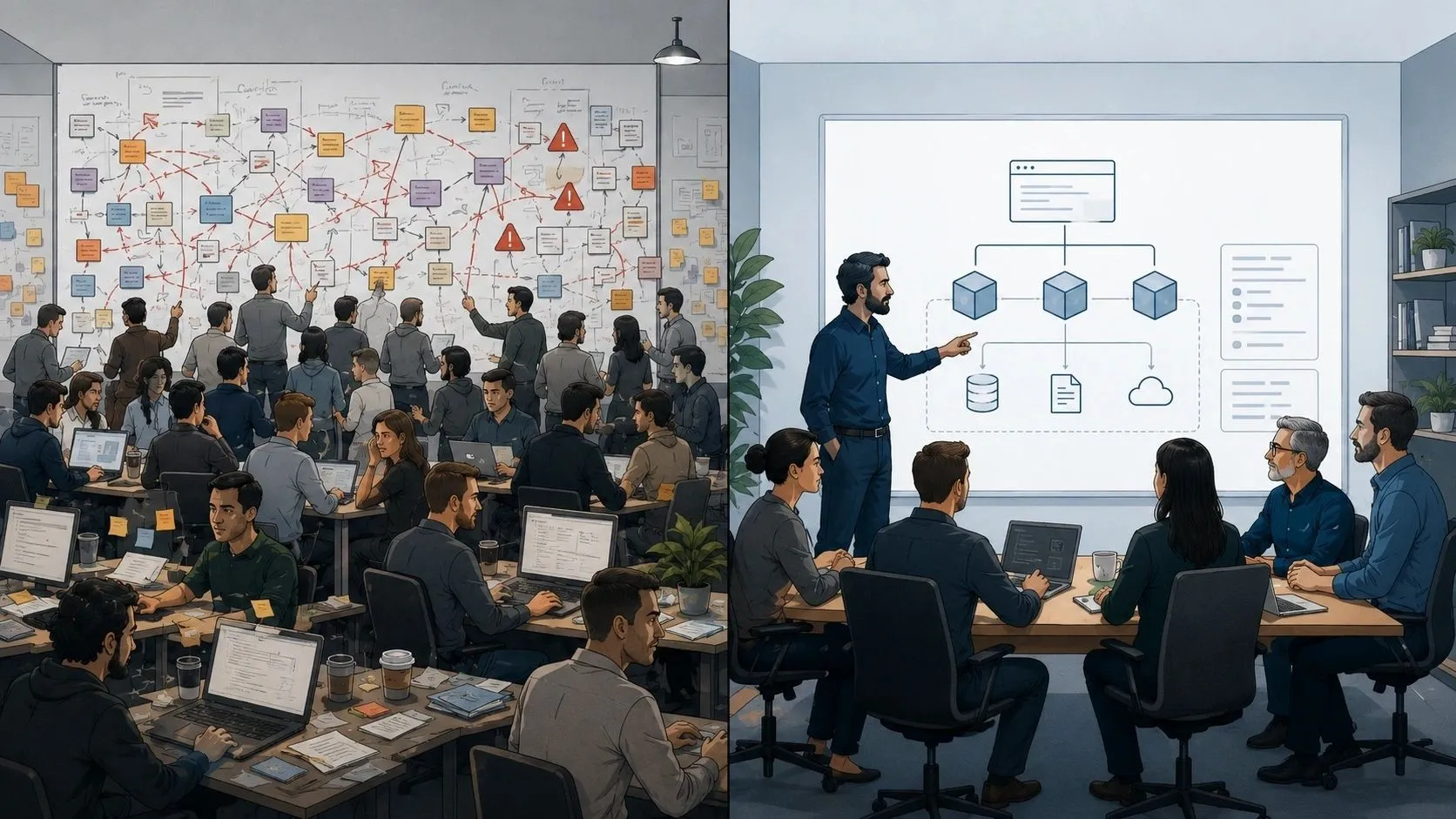
Enterprise AEM programs often start with the right ambition: centralize digital experience delivery, support multiple brands and markets, improve content reuse, and give business teams a scalable platform for growth. But after a few years, many organizations find themselves in a familiar situation: the AEM budget keeps growing, more vendors are added, more developers join the program, more processes are introduced, and yet delivery becomes slower.
Simple changes take weeks. Releases become risky. Teams spend more time coordinating than building. Different partners solve similar problems in different ways. Components, templates, integrations, and frontend approaches start to diverge. Eventually, the organization starts questioning whether Adobe Experience Manager itself has become too expensive.
In most cases, AEM is not the real problem. The problem is the delivery model around AEM. The best enterprise AEM programs are not necessarily the ones with the largest teams, the most vendors, or the most parallel workstreams. They are usually the ones with clear ownership, strong architectural discipline, a limited number of senior people making good long-term decisions, and a platform model that is designed to reduce technical debt, duplication and customization instead of multiplying it.
The Real Cost Is Hidden in Delivery
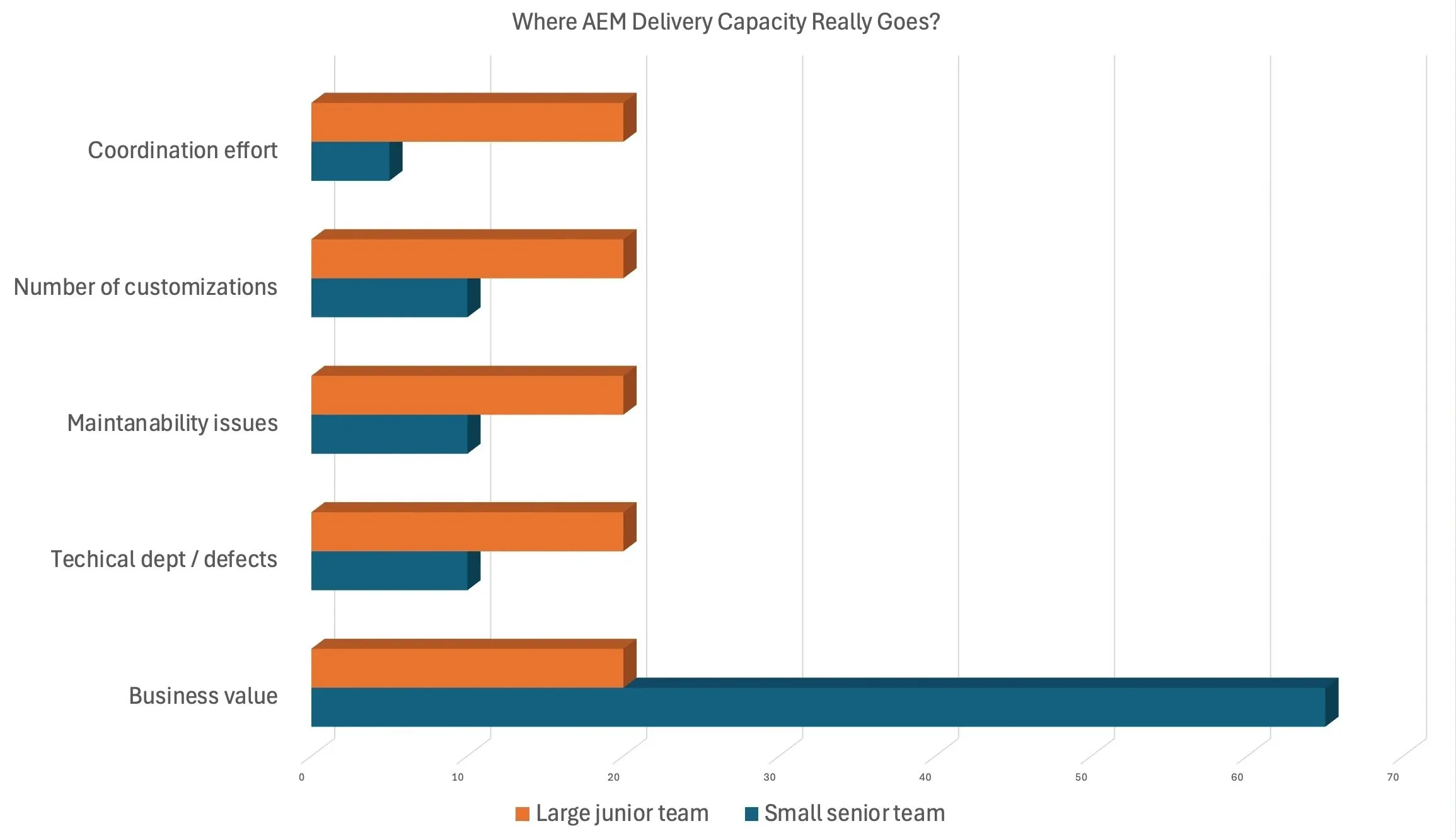
When enterprises discuss AEM cost, the conversation often starts with licensing, infrastructure, hosting, or migration effort. Those costs matter, but they are rarely the full story. The higher cost is usually hidden inside delivery: duplicated work, unclear ownership, vendor handovers, over-customization, repeated QA cycles, slow releases, and teams waiting for other teams.
A common reaction to slow enterprise delivery is to add more people. More backend developers, more frontend developers, more QA, more Scrum teams, more partner capacity, more architecture reviews, and more release coordination. On paper, this looks like progress. In reality, it often creates a larger system that is much harder to govern and scale.
AEM is not a simple task factory where doubling the number of developers doubles the output. It is a platform where architecture, content structure, authoring experience, integrations, performance, release quality, and long-term maintainability compound over time. If the delivery model is weak, adding more people can create more divergence, more customizations, more meetings, more defects, and more long-term maintenance work.
AEM budget waste often comes from patterns that look reasonable in isolation but become expensive at enterprise scale. Multiple vendors work on the same platform without a shared engineering model. Different teams create similar components for different brands. Every market request becomes a custom feature. Too much business logic is implemented directly inside AEM instead of being handled by dedicated cloud services. The frontend stack differs between teams or historical phases of the platform. Release processes become so heavy that small improvements require a large coordination effort.
None of these problems look dramatic on day one. But over several years, they quietly increase the cost of every new change. The platform becomes harder to understand, harder to test, harder to upgrade, and harder to extend. At that point, the organization is no longer paying only for new features. It is paying for the accumulated coordination, technical debt, and maintainability issues created by the delivery model.
When Lower Rates Create Higher Costs
Large delivery teams can look financially attractive when the hourly rate is low. But the hourly rate is only one part of the budget equation. The better question is not "what is the cheapest hourly rate?" The better question is "how much does the delivery model cost per month, and what business output does it produce?"
Let’s use a simplified example based on 160 hours per person per month. A 50-person offshore delivery setup at €25 per hour costs roughly €200,000 per month. At €35 per hour, the same setup costs roughly €280,000 per month. At €50 per hour, it costs roughly €400,000 per month.
Now compare that with a smaller senior European AEM team built around clear ownership: one CMS Solution Architect, two senior and one mid Backend Developers, two senior and one mid Frontend Developers, and one QA automation engineer. Using our public rates, that eight-person team costs €111,200 per month.
The issue is not offshore delivery by itself. The issue is when partners sell low-cost capacity as expertise. AEM is a specialized enterprise platform, and undertrained teams without strong architectural guidance can quickly create more cost than they save. A low hourly rate does not matter if the output requires constant rework, supervision, coordination, repeated QA cycles, and long-term maintenance issues that destabilize the complete platform.
If the delivery model requires 50+ people, multiple handovers, duplicated responsibilities, slow decisions, repeated QA cycles, and heavy coordination, the total monthly cost can easily exceed the cost of a smaller senior team with stronger ownership. In AEM programs, the most expensive unit is often not the developer hour. It is an unnecessary developer hour.
This is why smaller senior teams can often create more value, even when individual rates are higher. They do not create value because they are cheaper per hour. They create value because they need fewer hours, fewer handovers, fewer corrections, fewer layers of coordination, and fewer future maintenance cycles. They are more likely to solve the problem once, in the right place, in a way that can be reused across brands, markets, and future requirements.
A Real-world Example at Enterprise Scale
One large global enterprise platform we work on supports more than 130 brand websites on AEM as a Cloud Service. Some of these websites serve more than 50 markets and support complex regional and brand-specific requirements.
At first glance, this sounds like the type of environment that would require dozens of developers, multiple implementation partners, and a large delivery organization. In reality, the platform has been in production for more than five years with a compact core engineering team: three Backend Developers, three Frontend Developers, and supporting roles such as Solution Architect, PO, QA, and SM.
The reason this works is not because the scope is small. It works because the platform was designed with discipline. All websites rely on a common design system and a controlled set of roughly 30+ highly configurable components. Instead of creating a new component, template, or custom feature for every brand or market request, the team focused on reusable patterns that could support different brands, markets, and content needs without fragmenting the platform.
That decision has a direct budget impact. Fewer duplicated components mean less maintenance. A shared design system means faster rollout across brands. A smaller senior team means fewer handovers, fewer meetings, and faster decisions. Clear ownership means the team can make architectural decisions consistently instead of rediscovering the same answers across multiple vendors or workstreams.
Most importantly, the platform remains maintainable because it is not over-customized for every local requirement. When new requirements appear, they are evaluated against the existing platform model first. If the requirement can be solved through configuration, reusable components, or existing patterns, it does not become another one-off implementation. This is what keeps the cost of change under control over time.
This makes the difference between scaling AEM through headcount and scaling AEM through architecture. Scaling through headcount usually increases coordination. Scaling through architecture reduces the need for coordination because the platform itself provides clearer rules, reusable patterns, and fewer ways to solve the same problem.
When a Smaller Team Can Deliver More
A smaller senior team is not cheaper because senior people have lower rates. They do not. A smaller senior team is cheaper because it makes fewer expensive mistakes.
Experienced AEM teams understand when to build, when to reuse, when to configure, when to say no, and when a requirement does not belong inside AEM at all. They know that every custom component has a maintenance cost, every integration embedded directly into AEM creates future coupling, and every one-off solution becomes another exception someone must remember, test, document, and support.
This is also where seniority matters most. Senior AEM engineers and architects are not valuable only because they can implement complex features. They are valuable because they can prevent unnecessary complexity from entering the platform in the first place. They can see when a request will create technical debt, when a component will become too specific, when an integration should be externalized, when a frontend approach will not scale, and when a short-term delivery decision will become a long-term maintenance problem.
One of the most expensive mistakes in enterprise AEM programs is using AEM as the place where every feature gets built. AEM should own content structure, authoring experience, templates, components, publishing workflows, assets, permissions, and content delivery patterns. But not every business process belongs inside AEM.
Complex integrations, business rules, data processing, automation, reporting, pricing logic, customer-specific workflows, and specialized applications are often better handled by cloud services, APIs, middleware, or dedicated products built around AEM. This is not about making the architecture more complex, but keeping AEM focused on what it does best.
When AEM is used as the CMS and cloud services handle the surrounding, non-CMS logic, the platform becomes easier to maintain, easier to upgrade, and easier to scale across brands and markets. A smaller senior team can protect that boundary more effectively than a large fragmented delivery model where every team is trying to deliver its own scope, often without full ownership of the long-term platform impact.
Conclusion
Reducing AEM cost should not mean cutting corners, but removing waste. Start by reviewing how many teams and vendors are involved, what each team owns, where handovers happen, and how much work is duplicated across brands or markets. Then review the platform itself. How many components are actively used? How many were built for one-off requests? How many frontend approaches exist? How much non-CMS business logic lives inside AEM? Which integrations are tightly coupled? Which release steps are manual or overly dependent on specific people?
Finally, compare cost against business output. If budget is increasing but campaign velocity, author autonomy, reuse, performance, maintainability, and release confidence are not improving, the organization is probably funding operational friction rather than platform value.
If your AEM budget is going up but delivery is slowing down, the problem will not be solved by adding more developers. In many cases, adding more developers only increases the amount of coordination, review, testing, and architectural control required to keep the platform stable. The answer is usually better ownership, stronger standardization, fewer unnecessary customizations, and a clearer boundary between what belongs inside AEM and what should be handled by services around it.
A smaller senior team with the right architecture and ownership model can often deliver more value than a much larger fragmented delivery organization. Not because small teams are magically better, but because enterprise AEM platforms reward consistency, discipline, reuse, and maintainability more than raw development capacity. The real question is not how many people are assigned to an AEM project. The real question is whether the enterprise is paying for outcomes and stability or paying for coordination, duplication, and technical debt.
At Meticulous Digital, we help enterprises review where their AEM programs are losing value and help define a more maintainable platform model; learn more about our approach or start with one of our entry packages.