Headless using AEM Sites, not only Content Fragments
 Daniel Strmečki
Headless delivery in AEM is often associated with flexibility, performance, and modern frontend architectures. For developers, this usually sounds like a clear step forward. However, in many enterprise projects, headless has also introduced a major tradeoff: marketers and content authors lose access to many of the AEM Sites features and the familiar WYSIWYG editing experience they rely on every day.
This is why "headless AEM" is still too often reduced to "Content Fragments exposed through GraphQL APIs". Content Fragments are powerful and absolutely have their place, but they are not the only way to build headless experiences with AEM. At least not anymore.
With AEM as a Cloud Service, AEM Sites, and the Universal Editor, we can now take a more balanced approach: keep enterprise-grade content management and visual authoring in AEM Sites, while delivering experiences through a modern headless frontend architecture.
The Old Headless Tradeoff
Historically, many AEM headless projects started with a simple assumption: model the content as Content Fragments, expose it through GraphQL, and let the frontend handle the rest. This gives teams more freedom and improves the ability to deliver content across websites, mobile apps, kiosks, portals, and other touchpoints.
While this model works very well for many use cases, it also creates challenges when it is applied too broadly. For structured and reusable content, Content Fragments are a natural fit. But for full-page experiences, campaign pages, market-specific landing pages, and content that depends heavily on layout and context, a pure Content Fragment model can become difficult for authors to use.
Instead of editing a page visually, authors may end up editing disconnected content records. Instead of seeing the final experience in context, they may need to understand how different fields are assembled by the frontend. Instead of using familiar AEM Sites capabilities, teams may need to recreate parts of the authoring and governance process somewhere else. In many enterprise AEM projects, this becomes the real cost of headless. The frontend becomes more flexible, but content operations become harder.
Headless AEM ≠ Only Content Fragments
Content Fragments are one of the most important headless capabilities in AEM. They are excellent for structured, page-independent content that needs to be reused across channels. Articles, product information, FAQs, biographies, legal snippets, and mobile app content are all good examples where Content Fragments can provide a clean and scalable model. However, Content Fragments should not become the default answer to every headless requirement.
A page experience is often more than a set of structured content fields. It can include layout decisions, component ordering, market-specific overrides, inherited content, translations, approvals, personalization, tracking, and visual context. When all of that is forced into a pure Content Fragment model, complexity does not disappear. It usually moves into the frontend application, custom orchestration logic, or authoring conventions that are harder to govern.
This is especially important in enterprise AEM environments, where many clients are not starting from zero. They already have established AEM Sites implementations, trained authors, governance models and established processes. Replacing all of that with a purely Content Fragment-driven architecture can create unnecessary migration cost and operational risk.
Why AEM Sites Still Matter in Headless
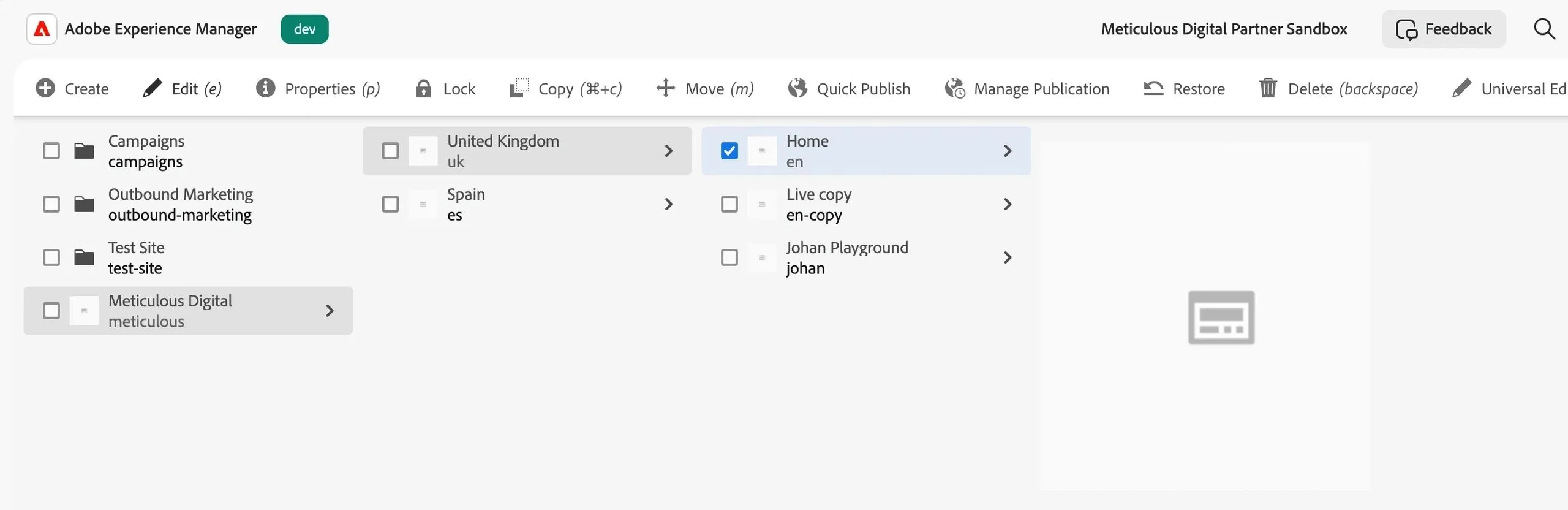
For clients already using AEM, AEM Sites is not just a page editor. It is usually the core content management layer for the organization. It is where authors create and manage pages, governance rules are applied, approvals happen, translations are initiated, and multi-market or multi-brand structures are managed through Multi-Site Manager (MSM).
A headless architecture that ignores this layer can quickly become very expensive. Not because the frontend technology is wrong, but because the organization loses the content operations maturity it has already built. This is where AEM Sites becomes very valuable in a modern headless architecture. Instead of replacing Sites, we can now reuse it as the enterprise content management layer and modernize the delivery layer around it.
Authors can continue working with familiar concepts such as pages, components, language copies, live copies, workflows, and approvals. Marketing teams can continue using the governance and localization processes they already know. Development teams can still build a new, modern, headless frontend and optimize delivery for performance.
For enterprise clients already on AEM, this is often the most realistic path. It avoids the false choice between keeping authoring features and getting modern delivery. With the right architecture, we can keep both.
Universal Editor Changes the Conversation
One of the biggest historical arguments against headless delivery was the loss of visual authoring. Developers were comfortable with APIs, models, and frontend frameworks, but authors often lost the ability to edit content in the context of the final experience.
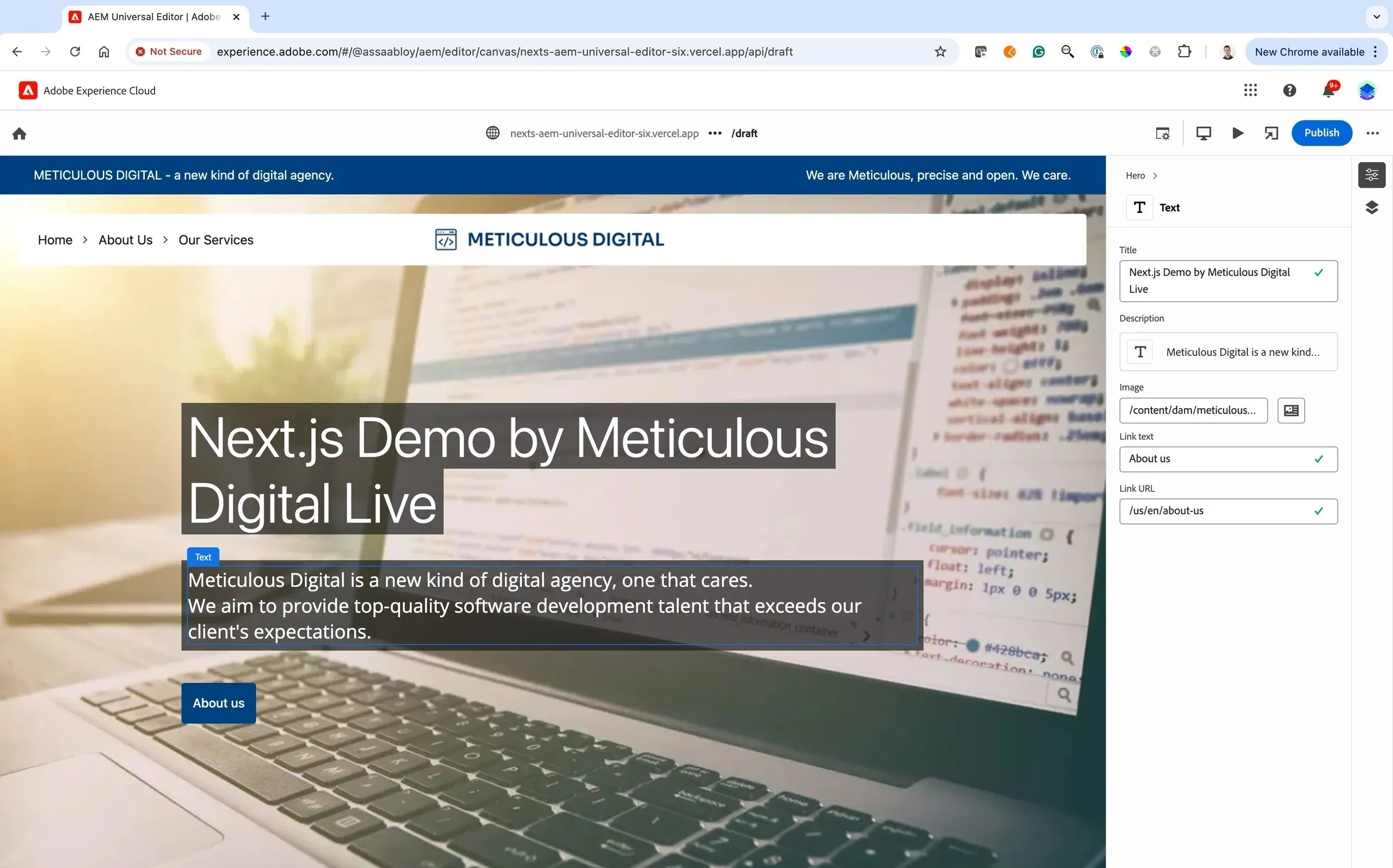
Universal Editor changed that conversation. It allows modern frontend experiences to be instrumented for visual, in-context editing. Authors can interact with the experience more naturally, while developers still keep the freedom to build with modern frontend technologies. This is a major improvement over a model where authors only edit fields and need to trust that the frontend will assemble them correctly.
Universal Editor has also become more realistic for enterprise AEM Sites use cases. Plugin support around MSM makes it possible to work with inherited content in a way that fits multi-market and multi-language AEM implementations. Richer component and field definitions also make it easier to support real-world authoring patterns, including multifields and nested component structures.
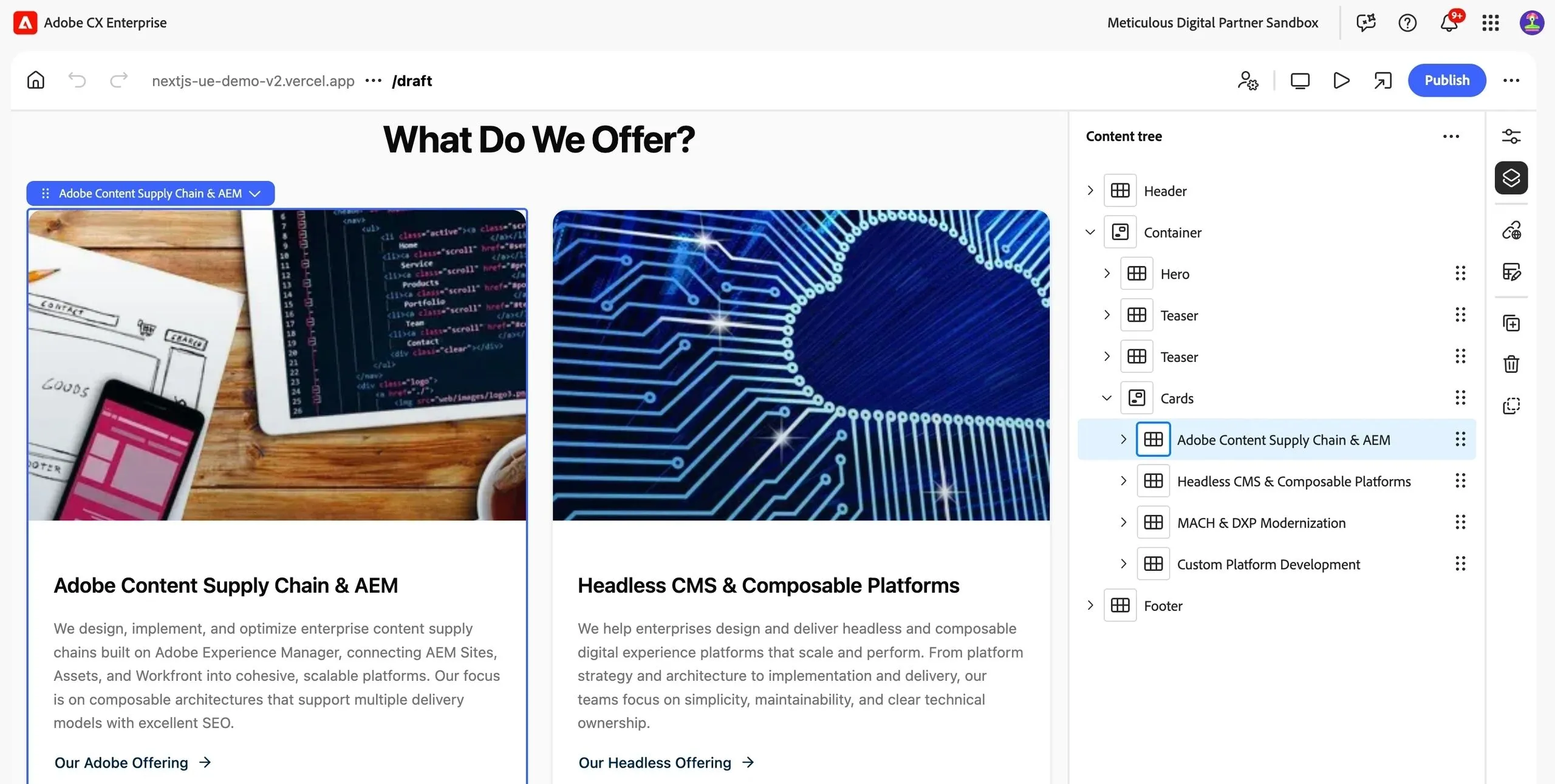
This is important because real enterprise components are rarely simple. A hero, teaser list, or card grid often needs nested fields, repeated items, CTAs, tracking metadata, and market-specific overrides. Universal Editor brings headless delivery closer to the authoring expectations AEM teams already have from Sites: visual context, editable components, inherited content awareness, and a content structure authors can understand.
A Better Architecture: Sites as CMS, Frontend as Delivery Layer
The new model is not traditional AEM Sites versus headless. It is AEM Sites plus modern frontend delivery. In this model, AEM remains the content management layer. It manages the page hierarchy, authoring experience, workflows, governance, translations, MSM, and permissions. Universal Editor provides the visual editing layer for modern frontend experiences. The frontend application owns rendering, user experience, performance optimization, and delivery.
Content Fragments still have an important role, but they are used where they make sense: structured, reusable, channel-independent content. AEM Sites is used where the experience depends on page composition, authoring context, governance, localization, and enterprise content operations.
This approach does not try to make AEM Sites look like a simple headless CMS. It uses AEM Sites for what it was built for, enterprise content management, allowing the frontend to focus on rendering, performance, and user experience.
A Practical Demo: Enterprise Authoring with Headless Delivery
This JAMStack architecture becomes much easier to understand when shown in practice. In a typical demo, an author can manage a page in AEM Sites using Universal Editor. The page can still participate in the same enterprise content processes where AEM Sites shines.
At the same time, the final experience is delivered through a modern frontend architecture optimized for speed and scalability. The frontend is not tied to traditional AEM rendering. It can be built, optimized, and deployed separately using modern frontend practices while still being powered by AEM content.
This is where the model becomes compelling for enterprise clients. They do not have to choose between authoring governance and frontend performance. They can keep AEM as the system for enterprise content management and still deliver fast, modern, headless experiences. When this is validated live with Lighthouse 100 scores, the message becomes even stronger. Performance does not require abandoning AEM Sites authoring. Modern delivery and enterprise authoring can work together.
Conclusion
Headless AEM should not be reduced to only Content Fragments. They remain essential for structured, reusable, channel-independent content. Still, many enterprise website experiences need more: visual editing, page context, workflows, translations, MSM, governance, and the operational maturity that already exists in AEM Sites.
With AEM as a Cloud Service, AEM Sites, Universal Editor, and modern frontend delivery, we can now build a more balanced headless architecture. One that gives developers flexibility and performance, while keeping authors inside the AEM Sites experience they already know. In other words: decouple delivery, not content operations.
Get in touch with us to schedule a free live demo and see how this approach could work for your AEM implementation.